
How to be a Cyclical Gym Girlie
as someone very unqualified to talk about fitness and qualified to talk about menstrual cycles
High up on the list of things that have changed my life (including but not limited to: colour analysis, tracking ovulation, batch cooking, freezing lemon juice into ice cubes) is strength training.
Prior to very recently I was NOT a gym girlie. I intermittently went to the gym to do my physio exercises and walk around the track. I danced and walked. Moving my body has always been integral to my mental health.
But I don’t know what overcame me except maybe divine intervention when I signed up for a women’s only strength training program.
Three times per week.
(P.S. This is my endorsement for The Gang Fitness in Winnipeg! 11/10 recommend!)
I thought perhaps I’d sign up for this program and then learn how to lift weights on my own and go to the gym on my own.
I’m lol’ing at my past self thinking that.
Going to the gym where I’m expected, where I work out with the same familiar faces, where I just do what’s on the board, where I do progressive overload and see the results of showing up for myself, has become lowkey addictive.
And what’s been fascinating is that my cycles, traditionally the most irregular of anyone I’ve ever worked with, have become like clockwork.
Tbh I’m a little scared to type that in case I jinx it.
Three regular cycles in and I’m confident I can now call myself a Cyclical Gym Girlie.
Working out through my menstrual, pre-ovulatory, ovulatory and luteal phases has been a fascinating experiment for someone who is more often than not in a very long follicular phase.
While I am suss of the Instagrammable cycle syncing narrative, I have noticed significant changes in how I train, sleep and recover through each phase of the cycle.
What follows isn’t a prescriptive “do this or you’re doing it wrong” cycle syncing plan.
It’s an evidence-based overview of what’s happening hormonally across the cycle, what I’ve noticed working through the phases, and how that tends to influence strength, recovery, sleep, and tolerance for training stress in people who ovulate.
Menstrual
(Day 1 of bleeding → end of bleeding)
Hormone levels are at their lowest here. Estrogen and progesterone have dropped, which is what triggered menstruation in the first place.
From a physiological standpoint, this is a low hormone, low inflammation reset phase.
Contrary to popular belief, menstruation itself is not inherently a weak state. In fact, some research suggests pain tolerance may be higher and perceived exertion lower for certain types of training during early menstruation—assuming symptoms are manageable.
What I’ve noticed is that particularly on cycle day 1 I tend to experience cramping and pain. Simply put, pushing myself hard in the gym doesn’t feel good. If cycle day 1 lands on a workout day I will opt for gentle stretching or lighter weight.
Note of warning: I will sometimes take ibuprofen on cycle day 1. What happened one cycle was that I took it before training and pushed my body too far because I didn’t have the signals from my body to ease off. I needed a few days recovery after that!
Training + Recovery Considerations
Energy can be variable. Some people feel flat, others feel surprisingly clear.
Lower progesterone means less thermogenic load, which can make training feel easier from a temperature and recovery standpoint.
Strength training is generally well tolerated if cramps, fatigue, or heavy bleeding aren’t limiting factors.
Practically, this is often a good phase for:
returning to baseline lifts
technique focused sessions
steady, moderate intensity strength work
Not because you have to go easy, but because your body isn’t juggling a lot hormonally.
If you feel like resting more here, that’s also normal. Menstrual symptoms, not a blanket hormonal profile, are often the deciding factor.
Pre-Ovulatory (Follicular) Phase
(End of bleeding → ovulation)
Estrogen rises steadily during this phase, while progesterone remains low.
This is typically where people notice:
improved mood
better sleep
faster recovery
increasing tolerance for training volume
Estrogen has a protective effect on muscle tissue and is associated with improved insulin sensitivity and connective tissue elasticity. Translation: your body is generally more resilient to training stress here.
When I train during my follicular phase, the best way I can describe it is I feel like a man. I notice explosive movements are easier, it takes me longer to feel fatigued.
It’s why this phase is also where many people experience the “I could train forever” effect—especially if they’ve been under training during more symptomatic phases of their cycle.
Training + Recovery Considerations
Higher tolerance for volume and progressive overload
Strength gains often feel easier to come by
Recovery between sessions tends to be faster
This is often a good time for:
pushing load or reps
learning new lifts
increasing training frequency
If you’ve ever felt like your workouts suddenly click, this phase is usually why.
Ovulatory Phase
(The few days surrounding ovulation)
Ovulation is marked by a sharp estrogen peak followed by a rise in progesterone.
This is often associated with:
high confidence
good coordination
high energy
peak performance in short bursts
There is evidence that maximal strength and power output can peak around ovulation for some people. Neuromuscular efficiency tends to be high, which can make heavy lifts feel surprisingly smooth.
However, estrogen also increases ligament laxity. This means ligaments are looser than usual. This doesn’t mean don’t lift. It means warm up properly and respect fatigue.
I do think, and this is where my skepticism with cycle syncing your workouts comes in, this is good advice no matter where you are in your cycle.
Training + Recovery Considerations
Great phase for heavy lifts, power, or performance based sessions
Be mindful of joint stability
If training feels amazing but recovery suddenly drops off afterward, that might be a sign that you’re transitioning into your luteal phase.
Luteal Phase
(Post ovulation → next period)
After ovulation, Progesterone is the dominant hormone.
It raises core body temperature, increases resting metabolic rate, and changes how the body uses fuel. Recovery becomes slower, sleep can be more important, inflammation can increase.
You’re doing more work just to exist.
Training + Recovery Considerations
Increased perceived exertion for the same workload
Longer recovery times between sessions
Greater need for sleep, calories, and rest days
Strength training is still beneficial here, but often better supported by:
slightly reduced volume
longer rest periods
fewer maximal efforts
Many people feel best shifting toward:
maintenance loads
slower, controlled lifts
prioritizing form and consistency over progression
This phase rewards showing up without overreaching.
I notice that I need more recovery, naps and rest after training but just in general when I’m in my luteal phase.
On the other hand, working out in my luteal phase can feel incredibly cathartic. Especially if I’m having a day.
My take on Working out With Your Cycle
This is where I disagree with cycle syncing: listening to your body, warming up, recovering, are all good things to do regardless of what phase of your cycle you’re in.
However, I have found that knowing which phase of my cycle I’m in has helped me work out more effectively by knowing when it’s most important to prioritize these things. It’s helped me plan ahead and have grace for myself when I’m not lifting as heavy. I remember that it’s not me, it’s my cycle.
Understanding the hormonal context and knowing when you ovulate helps explain:
why some weeks feel easy
why others feel heavy
why recovery needs change even when motivation hasn’t
It’s not an excuse to skip working out 50% of the time.
I actually find that going to the gym when I’m menstrual and just doing what I can helps me feel better in general and sets me up for a day where I feel really positive.
Instead, it’s a lens with which we can appreciate that we aren’t the same every day so we can’t expect to show up in the same way every day. And that is revolutionary.
Strength training didn’t fix my cycles (or did it?? Kind of feels like that).
But it clearly changed how my body handles stress.
And when training load, recovery, sleep, and hormones stop working against each other? Things get a lot more predictable.
Not perfect, but predictable.
Which, for someone with historically chaotic cycles, feels revolutionary. Let’s see how long it lasts.
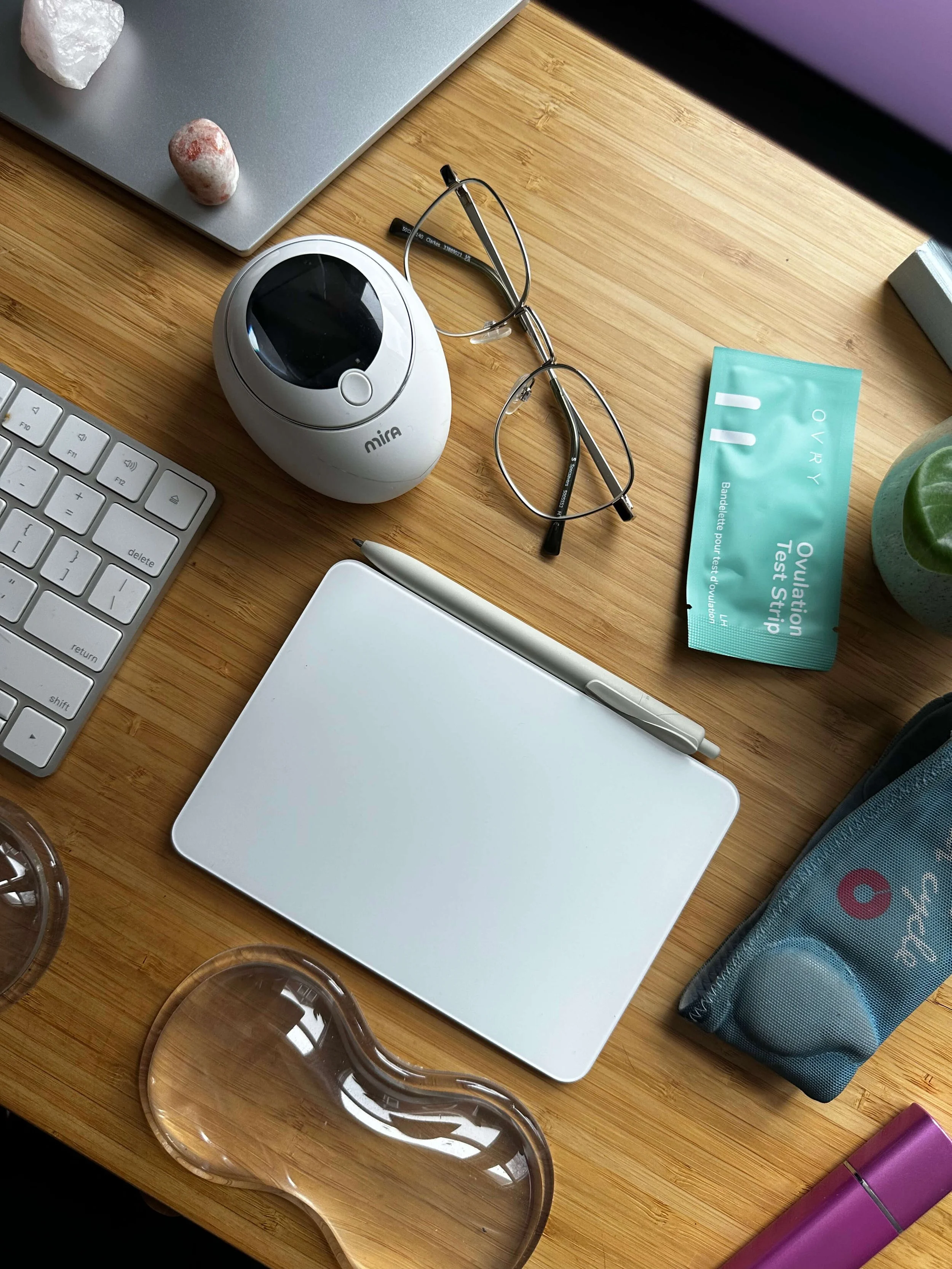
Knowing when you ovulate is actually the biggest life hack
I teach people how to chart their menstrual cycles for birth control